- Chapter Three Projects
- Chapter Four Projects
- Chapter Five Projects
- Chapter Six Projects
- Chapter Seven Projects
- Chapter Eight Projects
- Chapter Nine Projects
- Chapter Ten Projects
- Core-it Conference
- Cyber Skyline Website
- Digital Forensics: Getting Started with File Systems
- Getting Started with Windows Memory Forensics
Assignment and Study Guide for CISS360
Chapter One
Terms
- affidavit
- A notarized document. Under the penalty of perjury. Can be a declaration when the document in not notarized.
- allegation
- charge made before proof
- approved secure container
- A fireproof container locked by a key or combination
- attorney-client privilege(ACP)
- client information divulged to an attorney is confidential
- authorized requester
- Private domain: has the right to request an investigation.
- bit-stream copy
- A bit by bit duplicate of data on the original storage medium. Known as acquiring an image or making a forensic copy
- chain of custody
- The path that evidence takes from the start of an investigation until closed.
- Computer Technology Investigators Network(CTIN)
- Pacific Northwest group of investigators that collaborate on better investigative techniques
- data recovery
- recovering deleted files
- Digitial Evidence Specialist(DES)
- One who collects and protects the integrity of the data/evidence
- digital foresnics
- providing evidence through investigative procedures for legal purposes
- evidence bags
- Non static bags used to transport any computer components or digit devices
- evidence custody form
- A hard copy form showing who checked evidence in/out
- exculpatory evidence
- Evidence that indicates suspect in innocent
- exhibits
- Evidence used in court to prove a case
- forensic workstation
- A work station that copies evidence
- Fourth Admendment
- Ensures probable cause for search
- hostile work environment
- A workplace that prevents employees from doing their job due to hostile interaction from others
- inculpatory evidence
- Evidence that indicates suspect is guilty
- industrial espionage
- Theft of valuable proprietory information/data/ or products from a company that is
- International Association of Computer Investigative Specialist(IACIS)
- Software creators for digital forensics
- interrrogation
- Attempting to get a confession for a specific incident or crime
- interview
- Conversation conducted to collect information from a witness or suspect to verify related facts
- line of authority
- Order by which a problem in elevated through ranks. Each rank has the legal right to investigate and possess/control/access evidence
- multi-evidence form
- Evidence custody form used to list all items associated with a case
- network intrusion detection and incident response
- Detecting attacks from intruders by using automated tools and manual processes.
- professional conduct
- Expected behavior of a professional supporting ethical behavior and integrity.
- repeatable findings
- Duplicating a result continually to insure accuracy
- search and seizure
- Obtaining evidence legally
- search warrants
- Legal document providing the investigators the right to examine private property to support or prove an allegation
- single-evidence from verdict
- Form attached to each piece of evidence. Provides a log of evidence handling to ensure integrity of the evidence
- vulnerability/threat assessment and risk management
- Weakest points of an attack surface. Covers all types of security
- warning banner
- Provides instruction to the user for the proper use of the company computer
- white-collar crimes
- Financially motivated non violent crime. Typical white-collar crimes could include wage theft, fraud, bribery, Ponzi schemes, insider trading, labor racketeering, embezzlement, cybercrime, copyright infringement, money laundering, identity theft, and forgery
Review Questions
- 1. Digital forensics and data recovery refer to the same activities. True or False?
- False
- 2. Police in the United States must use procedures that adhere to which of the following? a. Third Amendment b. Fourth Amendment c. First Amendment
- b. Fourth Amendment
- 3. The triad of computing security includes which of the following? a. Detection, response, and monitoring b. Vulnerability assessment, detection, and monitoring c. Vulnerability/threat assessment and risk management, network intrusion detection and incident response, and digital investigation d. Vulnerability assessment, intrusion response, and monitoring
- 4. What's the purpose of maintaining a network of digital forensics specialists?
- 5. Policies can address rules for which of the following? a. When you can log on to a company network from home b. The Internet sites you can or can’t access c. The amount of personal e-mail you can send d. Any of the above
- d. Any of the above
- 6. List two items that should appear on a warning banner
- 7. Under normal circumstances, a private-sector investigator is considered an agent of law enforcement. True or False?
- False
- 8. List two types of digital investigations typically conducted in a business environment.
- Private and Public
- 9. What is professional conduct, and why is it important?
- Professional conduct infers ethical behavior and integrity.
- 10. What's the purpose of an affidavit
- Ties the evidence to a source with a level of creditability
- 11. What are the necessary components of a search warrant?
- Case number, Investigating organization, Investigator
- 12. What are some ways to determine the resources needed for an investigation?
- To define the objectives of the investigation
- 13. List three items that should be on an evidence custody form.
- Date, case number, investigators organization and investigator's name name
- 14. Why should you do a standard risk assessment to prepare for an investigation?
- To understand risk associated with investigation.
- 15. You should always prove the allegations made by the person who hired you.
- False
- 16. For digital evidence, an evidence bag is typically made of antistatic material. True or False?
- true
- 17. Why should evidence media be write-protected?
- To protect the data from accidental deletion.
- 18. List three items that should be in your case report.
- The process addressed, steps you took and description of findings
- 19. Why should you critique your case after it's finished
- To improve your technique and provide a log to review for future cases
- 20. What do you call a list of people who have had physical possession of the evidence?
- chain of custody
- 21. Data collected before an attorney issues a memo for an attorney-client privilege case is protected under the confidential work product rule. True or False?
- True
Chapter One notes from Power Point Slides
- ISO standard for digital forensics was ratified in October 2012
- To insure a standard for Security techniques.
- Federal Rules of Evidence (FRE)
- Ensured consistency in federal proceedings
- FBI Computer Annalysis and Response Team (CART) was formed to handle cases involving digital evidence
- was formed to handle cases involving digital evidence
- CART
- teamed up with the Department of Defense Computer Forensics Laboratory
- Fourth amendment protects everyone' right to be secure from search and seizure
- Every U.S. Jurisdcition has case law regarding evidence recovered from computers and other digital devices
- This ensures the legality of the process
- In terms of forensics investigating digital devices means:
- Collecting data securely
- investigating suspect data for origin and content
- Presentation of forensic data to courts
- Applying laws to digital device practices
- Digital forensics is differrent from data recovery.
- Data recovery is retrieving information that was deleted by mistake or lost
- Forensics investigators often work as part of a team, know as an investion _____________?
- Triand
- A triand is three sides of a triangle...name them?
- 1. Vulnerability and threat assessment and risk management.
- 2. Network intrusion detection and incident response
- 3. Digital Investigations
- History of Digital Forensics
- 1990's International Association of Computer Invertigative Specialist (IACIS)
- IRS created search-warrant programs
- ASR Data created Expert Witness for Macintosh
- ILOOK maintained IRS Criminal Investigation Division
- AccessData Forensic Toolkit (FTK) is a popular commercial product
- When statue's don't exist, case law is used
- Allow legal counsel to determine if "Case law can be presuade"
- Examiners must be familiar with recent court rulings on search and seizure in the electronic environment
- How can I "To supplement your knowledge"
- Develop and maintain contact with computing, network, and investigative professionals
- Join computer user groups in both the pubic and private sectors
- TRY: Computer Technology Investigators Network (CTIN)
- Consult outside experts
- Public-sector investigations involve government agencies responsible for criminal investigations and prosecution
- Fourth Amendment to the U.S. Constitution•Restrict government search and seizure
- When conducting public-sector investigations, you must understand laws on computer-related crimes including
- Standard legal processes•Guidelines on search and seizure•How to build a criminal case
- The Computer Fraud and Abuse Act was passed in 1986
- Specific state laws were generally developed later
- How does a criminal investigation start?
- 1. Witness or victim makes an allegation to the police
- 2. Police interview the complainant and writes a report about the crime
- 3. Report is processed and management decides to start an investigation or log the information in a police blotter
- 4. Blotter is a historical database of previous crimes
- DEFR
- First Responder, assesses, takes precaution and acquires and preserves evidence
- DES Digital Evidence Specialist
- Has the skill to analyze the data and determine when to use another specialist
- Affidavit..sworn statement to support facts about or evidence of a crime and must include exhibits
- Private sector uses legal means to address violations of company policies and litigation disputes. ie wrongful termination
- Businesses strive to minimize litigation
- Private sector crimes can involve harassement, email problems, falsification of data, gender and age discrimination, embezzelment, sabotage and industrial espionage
- Businesses can publish policies to reduce risk of litigation
- Post policies that define rules for computer and the network
- What is a line of authority?
- States who has the legal right to intiate an investigation.
- How does a warning banner help?
- A warning banner post a message stating company policy and divulges the r right to monitor use.
- What are examples of an authorized requester?
- Corporate Secuirty investigations
- Corporate ethics office
- Corporate equal employment opportunity office
- internal auditing
- General counsel or legal department
- Private investigations search for What?
- Evidence to support allegations of violation of company policy
- What three common situations?
- Abuse or misuse of computing assets
- E-mail abuse
- internet abuse
- What positive outcome does a private investigator seek?
- Minimizing risk to the company.
- BYOD creates what kind of problem?
- When it is attached to the network, one does not know who owns it.
- What do some companies policies state when you connect a BYOD to your network?
- They take ownership of the device.
- What are characteristics of Professional conduct?
- Ethical, maintains objectivity and confidentiality. Invest in continual education to stay current.
- What is an investgators job?
- To gather evidence in order to prove allegations of violation of company policy.
- What is the purpose of collecting evidence?
- Investigate the suspect's computer
- Preserve the evidence to another computer
- Make it available to the courts and corporate inquires.
- Protect the chain of custody.
- Why are computers so important to an investigator?
- Computer both harbor evidence and contain evidence which can lead to conviction.
- What is important when acquiring evidence?
- Making sure evidence is not altered and or deleted
- Potential evidence might be password protected
- What are common misuses of computers?
- surfing the internet
- Sending personal emails
- Using company computers for personal tasks.
- What are the steps for problem solving?
- What type of case is it?
- Design the approach
- Detailed checklist
- Determine resourcs
- Obtain and copy an evidence drive
- identify the risks of losing the investigation
- Minimize risk of compromising the investigation
- Test the design you have for the investigation
- Analyze and recover the digital evidence.
- Investigate the data you recovered
- Complete the case report
- Critique the case
- How do you systematically outline the case details?
- Define the situation
- Determine the nature of the case
- List the specifics of the case
- What type of evidence do you need.
- Determine disk format
- Locate the evidence
- Based on these above factors you can determine the requirements for the case
- What most a baics investigation plan include?
- Acquire the evidence
- Complete the evidence form and establish chain of custody
- Transport the evidence to a computer forensics lab
- Secure evidence in an [approved secure container]
- Prepare your [forensics workstation]
- retrieve the evidence from the secure container
- Make a forensic copy of the evidence
- Return the evidence to a secure container
- Process the copied evidence with computer forensics tools
- What are two types of [evidence custody form] also known as:?
- chain of evidence form
- [Single evidence form]
- [Multi-evidence form]
- What is an example of a [multi-evidence form]. This form is missing a signature line at the bottom.
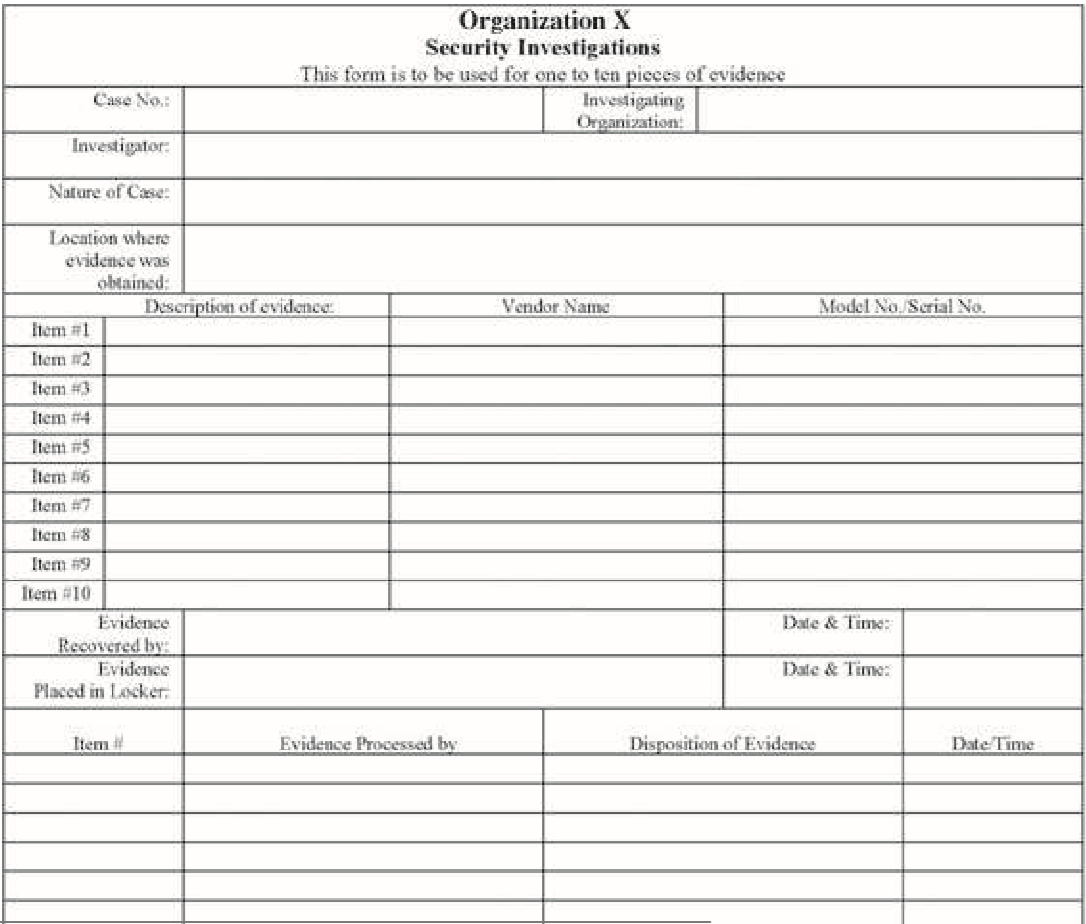
- What are important steps to take when securing evidence?
- Use evidence bags
- Computer safe products when collecting evidence like antistatic bags and pads
- Use padded containers
- Use tape to seal containers
- Use CD drive bays
- Use insertion slots for power supply electrical cords and usb cables
- write intials on tape to prove "no tampering"
- Make sure you have a safe environment for transporting and storing
- What is a general overview of procedures you need to develop as an investigator?
- Informal checklists
- Make sure you know all the issues
- ensure the correct techniques are used in an investigation
- Employee termination is usually due to?
- Abuse of corporate assest
- Creating a hostile workplace
- Viewing pornography
- Sending inappropriate emails
- In an organization what ensures or minimizes inappropriate conduct?
- Posted policies
- For internet abuse cases what does a investigator need to processs a case?
- Organization's internet proxy server logs
- Suspect computer's ip address
- Your preferred computer forensics analysis tool
- What are the recommended steps for an Internet Abuse investigation
- Use standard forensic analysis techniques and procedures
- Use appropriate tools to extract all Web page URL information
- Contact the netowrk firewall administrator and request a proxy server log
- Compare the data recovered from the forensic analysis to the proxy server log
- Continue anlyzing the computer's disk drive data
- How do you conduct an email abuse investigation?
- Electronic copy of the offending email that contains the message header
- email server logs
- access local email server if messages stored there
- Access the computer so you can perform an forensic analysis on it
- Use your preferred computer forensics analysis tool
- What are the recommended steps?
- Use the standard forensic analysis
- Obtain an electronic copy
- Use FTK Internet Keyword Search option to extract all related email address information
- examine header data of all messages
- What are the rules for ACP or Attorney Client Privelege?
- You must keep findings confidential
- Have printouts of data you recovered
- Attorneys must follow the rules for examining digital evidence
- Make sure you understand the format the data.
- What are the steps for an ACP investigation?
- Obtain permission from [line of request]
- List keywords of interest to investigation
- Initiate the investigation with a plan
- Make two bit stream images using different tools for each image
- Compare hash signatures on all files to the original and re-created disks
- Methodically examine every portion of the disk drive and extract all data
- Run keyword searches on allocated and unallocated disk space
- Windows OS's extract relevant registry entries
- For binary data files such as CAD drawings, locate the correct software product
- For unallocated data recovery, use a tool that removes or replaces nonpritable data
- What are the steps for conducting an ACP case?
- Consolidate all recovered data from the evidence bit-stream image into folders and subfolders
- Minimize written communications with the attorney
- Any communication written to the attorney must contain a header stating that it is "Priveleged Legal Communication-Confidential Work Product
- Assist the attorney and paralegal in analyzing the data
- Industrial espionage should be treated as criminal investigation
- Staff needed
- Digital investigator who is responsible for disk forensic examination
- Technology specialist who is knowledgeable of the suspected compromised technical data
- Network specialist who can perform log analysis and set up network sniffers
- threat assessment specialist (typically an attorney
- Guidelines when initiating an investigation
- Determine whether this investigation involve a possible industrial espionage incident
- Consult with legal advice/upper management
- How to substantiate the allegation
- Create list of keywords for disk forensics and sniffer monitoring
- List and collect Resources for the investigation
- Determine goal and scope of investigation
- Planning considerations:
- Examine all e-mail of suspected employees
- Search internet newsgroups or message boards
- Initiate physical surveillance
- Examine facility physical access log for sensitive areas
- Determine suspect location relative to asset
- Study suspects work habits
- Collect outgoing and ingoing phone logs
- Steps to conducting an industrial espionage case
- Brief personnel on the plan
- Gather resources to conduct the investigation
- Place surveillance systems at key locations
- Discreetly gather any additional evidence
- Collect all log data from networks and email servers
- Report regulary to management and corporate attorneys
- Review the inestigation's scope with management and corporate attorneys
- Become a skilled interviewer and interrogator
- Interview witness or suspect
- Interrogation to get a suspect to confess.
- Role as a digital Investigator
- To instruct the investigator conducting the interview on what questions to ask and what the answers should be
- Ingredients for a successful interview or interrogation
- Being patient throughout the session
- repeating or rephrasing the question to zero in on specific facts
- Being tenacious
- forensics lab or data-recovery lab
- In data recovery, the customer or your company just wants the data back
- Computer forensics workstation
- A specially configured PC
- Loaded with additionals bays and forensics softwar
- To avoid altering the evidence use:
- write-blockers devices
- enable you to boot to windows without writing data to the evidence drive
- Basic Requirements
- A workstation running Windows 7 or later
- a write-blocker device
- Digital forensics acquistion tool
- Target drive to receive the source or supect disk data
- Spare PATA or SATA ports
- USB ports
- Additional useful itmes
- Network interface card (NIC)
- extra usb ports
- firewire 400/800 ports
- SCSI card
- Disk editor tool
- Text editor tool
- Graphic viewer program
- other specialized viewing tools
- gather resources indentified in investigation plan
- Items needed
- Original storage media
- evidence custody form
- evidence container for the storage media
- Bit-stream imaging tool
- forensic workstation to copy and examine your evidence
- Securagle evidence locker, cabinet, or safe.
- Avoid damaging the evidence
- Bit-stream copy
- Difference gets all bits on the disk, not just a backup. All slack and out of sector information
- Bit-streams image
- Known as an image and copies all data on a partition.
- Important: Use a duplicate storage medium that matches manufactur's size and model
- Acquiring an Image of evidence media
- First rule: Preserve the original evidence
- Conduct your analysis only on a copy of the data
- Vendors provide acquisition tools
- Windows tools require a write-blocking device when accquiring FAT or NTFS
- What rates a good a complete job to get data?
- Deleted files
- File fragments
- complete files
- Process name for deleted files?
- Autopsy
- Steps to analyze a USB drive
- Start Autopsy
- Create a new case
- Type the case name
- Select the working folder
- Steps to add source data
- Select data source type
- Select image file
- Keep the default setting in the configure Ingest Module window...
- Steps to display the contents of the acquired data
- Click to expand Views, File types, By Extension, and Documents
- Select the file to display
- tag and comment
- New Tag Name
- What is the goal in analyzing the data
- Search for information related to the complaint
- Data analysis can be time-consuming task
- Autopsy
- Search for keywords
- Display results
- Click each file in the search results
- export data
- Search for specific filenames
- Generate a report of all your activities
- Additional features of autopsy
- Display binary (nonprintable) data in the content viewer
- Learn how to use Autopsy to build a report
- Make sure you include the Autopsy program finding in your report
- Why is "repeatability so important"
- Proves that it is not a intermittent result.
- Why use a template?
- Standarizes report and give you a form log that you can critique or edit over time.
- Report objectives are findings of conclusive evidence.
- Suspect did or did not commit crime.
- Important: Keep a written journal of everything
- Remember your notes can be used in court
- Answer the six W's...yotnew
- Requirement: You must also be able to explain the workings of the computer and network processes
- Autopsy Report Generator:
- html
- excel
- Text
- Steps for Industrial Espionage
- Gather all personnel and brief
- Organize resources
- Place surveillance systems at key locations
- Discreetly gather any additional evidence
- Colloect all log data
- Report regularly to management
- Review investigation's scope and report.
- Skilled interviewer and interrogator
- Interview: get facts to support
- Interrogation: Process of trying to get a suspect to confess
- Role as digital investigator
- To instruct the investigator on what to ask and what the answers should be.
- What are the ingredients for an investigations?
- Patience
- Repeating or rephrasing question to zero in on specific facts.
- Tenacity
- Data Recovery
- Just want their data back vs Forensic for evidence
- Forensic workstations
- Specifically configured Pc or Apple
- Has special bays and forensic software
- How do you protect the evidence?
- Write blockers are used which protects data during boot
- What are the basic requirements for a Digital workstation
- Win 7 or later
- write blocker
- Digital evidence software to capture data
- Digital forensics analysis tool
- Target drives
- Spare PATA and SATA ports
- extra usb ports
- What questions should you ask?
- Performance: improve your overall techniques?
- Did the case develop the way you wanted it...bias!!s
- Documentation: was it thorough?
- Requesting source...did you get any feedback? postive/negative
- New enlightening problems that can be logged and discussed.
- Did you introduce new techniques and if so how did it work out?
- Digital forensics involves systematically accumulating and analyzing digital information for use as evidence in civil, criminal, and administrative cases
- Investigators need specialized workstations to examine digital evidence
- Public-sector and private-sector investigations differ; public-sector typically require search warrants before seizing digital evidence
- Digital forensics involves systematically accumulating and analyzing digital information for use as evidence in civil, criminal, and administrative cases
- Investigators need specialized workstations to examine digital evidence
- Public-sector and private-sector investigations differ; public-sector typically require search warrants before seizing digital evidence
- Internet abuse investigations require examining server log data
- For attorney-client privilege cases, all written communication should remain confidential
- A bit-stream copy is a bit-by-bit duplicate of the original disk
- Always maintain a journal to keep notes on exactly what you did
- You should always critique your own work
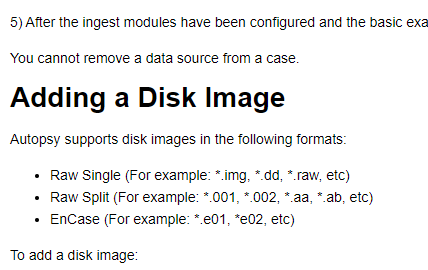
- https://www.autopsy.com/download/ and downloaded Autopsy msi for 64 bit windows
- Autopsy file types
- You need to create a case before you can analyze data in Autopsy. A case can contain one or more data sources (disk images, disk devices, logical files). The data sources can be from multiple drives in a single computer or from multiple computers. Each case has its own directory that is named based on the case name. The directory will contain configuration files, a database, reports, and other files that modules generates. The main Autopsy case configuration file has an ".aut" extension.
- Companion Web site address for Lab Files
- Finish Chapter one lab for George Montgomery investigation using Autopsy: George Montgomery Report
- AANSI-ASQ National Accreditation Board (ANAB)
- Provides accreditation of crime and foensics labs world wide
- accreditation includes forensics labs that analyae digital evidence
- Audits lab function and procedures
- business case
- Is the process of documenting a plan to meet the needs of management or the public. The goal of the business case is to acquire newer and better resources to investigate digital forensic cases. Public agencies don't always have to prove cost recovery.
- Certified Computer Examiner (CCE)
- Sponsored by the International Society of Forensic Computer Examiners.
- Certified Cyber Forensics Professional (CCFP)
- Program sponsored by ISC which requires knowledge of digital forensics, malware analysi, incident response and e-discovery
- Certified Forensic computer Examiner (CFCE)
- Candidates who complete the IACIs sponsored test successfully are designated as a Certified Forensic computer Examiner. Requires re certification every three years
- configuration management
- digital forensics lab
- High Tech Crime Network (HTCN)
- Offers several levels of certification. HTCN requires a review of all related training including training in one of its approved courses and a review of the candidate's work history. Certification includes Certified Computer crime Investigator, Basic and Advanced. Certified Computer forensic Technician Basic and Advanced
- risk management
- Risk management involves determining how much risk is acceptable for any process or operation. On the other hand a criminal forensic lab is at higher risk then a coroporate forensic lab. A regional lab might require more security to manage risk then a local small lab.
- secure facility
- TEMPEST
- Uniform Crime Report
- 1. An employer can be held liable for e-mail harassment?
- True
- 2. Building a business case can involve which of the following?
- b. All of the above which is Procedures for gathering evidence. Test software. Protecting trade secrets.
- 3. The ANAB mandates the procedures established for a digital forensics lab.
- True, ANAB audits lab functions and procedures
- 4. The manager of a digital forensics lab is responsible for which of the following? (Choose all that apply.) a. Making necessary changes in lab procedures and software b. Ensuring that staff members have enough training to do the job c. Knowing the lab objectives d. None of the above
- d none of the above
- 6. What items should your business plan include?
- 7. List two popular certification programs for digital forensics.
- 8. Why is physical security so critical for digital forensics labs?
- To protect the integrity of the evidence and prevent destruction and the losing evidence.
- 9. If a visitor to your digital forensics lab is a personal friend, it's not necessary to have him or her sign the visitor's log.
- False
- 10. What three items should you research before enlisting in a certification program?
- 11. Large digital forensics labs should have at least ________ exits.
- 2
- 12. Typically, a(n) ________ lab has a separate storage area or room for evidence.
- regional Forensics labs
- 13. Digital forensics facilities always have windows. True or False?
- False
- 14. Evidence storage containers should have several master keys. True or False?
- False
- 15. A forensic workstation should always have a direct broadband connection to the Internet. True or False?
- false
- 16. Which organization provides good information on safe storage containers?
- NISPOM
- 17. Which organization has guidelines on how to operate a digital forensics lab?
- 18. What term refers to labs constructed to shield EMR emissions?
- TEMPEST
- What is the prefered workstation for a forensic investigation?
- State of art processors speced with cache, at least 32 gb of ram or more and secondard sd drives, usb 3 and SATA hard disks. Slower workstation can be used more mundane task.
- What resource is important to recovering unusual systems?
- Online resources such as blogs and forums. You can subcontract the work to larger forensic labs who have more resources.
- What is a key resource for forecasting workloads?
- Criminal statistics collected that is related to population variables and census. Crimes can be quantified by ratios drawn from known population studies and counts.
- Are Laptops are now powerful enough to aid in forensic investigations?
- Yes and provide a tool that can be used outside of the lab. Laptops can get images in the field.
- Does the use of laptops increase the attack surface of a forensic lab?
- Yes, laptops can be easily stolen when they are outside of the lab.
- What facilitates a workstation crack passwords?
- Multiple graphics processing units (GPU's)
- Why is it important to plan for a Disaster recovery?
- You are exposed the physical problems like lightening strikes, water damage and fires. A good offsite backup policy is important. Also the ability to deal with viruses introduced to your network from external devices you are examining.
- What is configuration management?
- This provides the status of your system configurations. Confguration management also provides versioning control. Documenting changes is essential. You could use a program to capture system state and configuration status. Belarc is suggested by the author which inventories applications, hardware, and system configurations. A database can help or at least a handwritten log
- Advanced Forensic Format (AFF)_
- This is an open source format that has many desireable options such as compression, segment volumes, entensibility, file extension for metadata and authentication routines.
- host protected area (HPA)
- live acquisitions
- Live acquisitions, file metadata, such as data and time values changes when read by an acquisition tool. With live acquisition, file metadata, such as data and time values, changes when read by a aquisition tool
- Logical acquisition
- raw format
- Is a bit by bit copy from one disk to another disk of the same size or larger. The copy technique creates simple sequential flat files to a suspect drive or data set.
- redundant array of independent disk (RAID)
- sparse acquisition
- static acquistions
- a static acquisition is not accessed by other processes that can change. When you make a second static acquisition you produce the same results.
- whole disk encryption
- 1. What's the main goal of a static acquisition?
- Your goal is to preserve the digital evidence and that it can be verified.
- 2. Name the three formats for digital forensics data acquisitions.
- 3. What are two advantages and disadvantages of the raw format?
- The advantages of raw format are fast data transfers and the capability to ignore minor data read errors on the source drive. The majority of tools read raw data making it the standard capturing technique.
- Some disadvantages: Raw format takes a lot of disk space. Marginal data that is not easy to read without multiple passes is not read well by cheaper freeware software. Commercial products reread bad sectors and data which give the investigator more data to work with. That data could of been deleted or intentionally compromise in an attempt to hide it.
- 4. List two features common with proprietary format acquisition files.
- Analysis tool can be programmed with more options to work with the format. Proprietary formats are usually programed to retrieve weakly read data with more proficiency.
- Is it wise to verify reads from several different vendors to ensure you are getting all the data possible in raw format?
- Yes testing and reverifying reads support the integrity of your data.
- How do commercial products work to give the investigator a higher level of confidence?
- They perform cyclic redundancy Checks (CRC32) and use Message Digest 5 (MD5, and Secure Hash algorithm (SHA-1 or later) hashing functions. A separate file is created containing the hash value along side other files which alters the whole image if you are trying to make an exact duplicate on a duplicate drive or oversized storage device.
- What is a Proprietary format and why would it be used when you can use a standard raw format?
- Propretary formats allow the vendor to extend or facilitate other analysis tools that might be packaged with the specific vendors suite of software.
- What are some of the features or options that a Proprietary format can offer?
- 1. Options to compress
- 2. Option to split images and provide data integrity checks between the splits.
- 3. The oppurtunity to add or integrate metadata into the image file
- What is another disadvantage of proprietary format acquistions?
- Proprietary software does not talk to other software tools because of the proprietary file extension or format used.
- Expert Witness Compression format is currently the unofficial standar. What kind of file extension does it use for the segmanets or files/volumes that it produces?
- .e01 with increments for each additional segment image volume.
- What is the "Advanced Forensic Format"?
- It is open source format for data copying.
- It can produce compressed and uncompressed image files
- No size restriction for disk to image file
- Simple design but can be extended
- Compatible with multiple computing platfors
- Has a consistency checking process for verification
- How are file extensions different for segmented files and metadata using the "Advanced Forensic Format"
- .afd for segmented and .afm for metadata.
- What is the preferred way to acquire data?
- Static acquisitions is preferred live acquistions. If a computer has an encryted drive then a live aquistion is the only way to acquire the data since a password has to use a process to work before the data is accessible.
- What are the four methods of data acquisition?
- Creating a disk to image file
- disk to disk copy
- logical disk to disk or disk to data file
- creating a sparse copy of a folder or file
- What is the most common method for duplicating data?
- Disk to Disk image file which provides the most options for your investigation. These bit to bit replications
- How are older drives a problem for disk to image files?
- The target disk's geometry (its cylinder, head, and track configuration) might have to be adjusted
- Copying Data from a large drive can take a long time and might not be feasible. What might you do to mitigate the problem?
- You can use a logical acquistion where you choose specific files of interest.
- a sparse qcquistion is similar but also collects fragments of unallocated space and deleted data.
- Lossless compression versus lossy compression.
- Lossy compression can change data. Lossless compression does not change data.
- What is a good way to confirm lossless compression?
- Use a hash on the file before and after it is compressed. It is advisable to use two different hashes
- What is a drive's HPA?
- It is the Host Protected Area of the disk.
- Some acquisition tools don't copy data in the host protected area (HPA) of a disk drive. Check the vendor's documentation to see whether its tool can copy a drive's HPA. If not, consider using a hardware acquisition tool that can access the drive at the BIOS level, such as Belkasoft or ILookIX IXImager, with a write-blocker Image MASSter Solo' or X-Ways Replica. These tools can read a disk's HPA.
- A note about copying data from an HPA.
- Although many digital forensics vendors have improved their acquisition tools' some older Windows and Linux tools (such as the dd or dcfldd commands) can't acquire data from a disk's HPA.
- What problems arise with newer operating systems in copying disk?
- Newer operating systems (windows) use whole disk encryption with bitlocker.
- Describe Mini-WinFE Boot CDs and USB drives and how they function.
- Mini-WinFE allows you to write block with a registry hack.
- Linux provides some Live CD's for Digital forensics
- computer-generated records
- Not hearsay. Computer-generated records are data the system maintains, such as system log files and proxy server logs. They are output generated from a computer process or algorithm, not usually data a person creates.
- computer-stored records
- These are records that a person creates. Computer-generated and computer-stored records must also be shown to be authentic and trustworthy to be admitted into evidence. Computer-generated records are considered authentic if the program that created the output is functioning correctly. These records are usually considered exceptions to the hearsay rule. For computerstored records to be admitted into court, they must also satisfy an exception to the hearsay rule, usually the business-record exception, so they must be authentic records of regularly conducted business activity. To show that computer-stored records are authentic, the person offering the records must demonstrate that a person created the data and the data is reliable and trustworthy—in other words, it wasn’t altered when it was acquired or afterward.
- covert surveillance
- cyclic Redundancy Check (CRC)
- digital evidence
- Information stored or transmited in digital form. Digital digital data is treated as a tangible object.
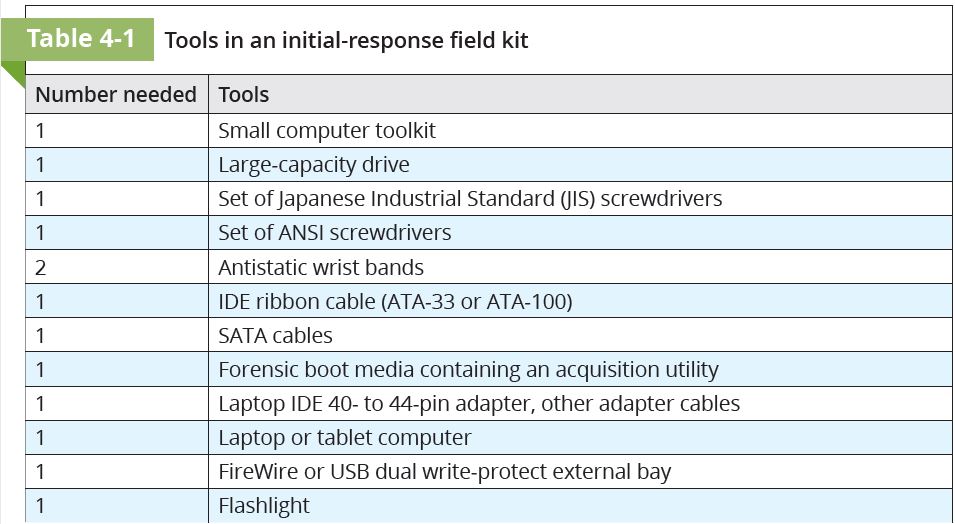
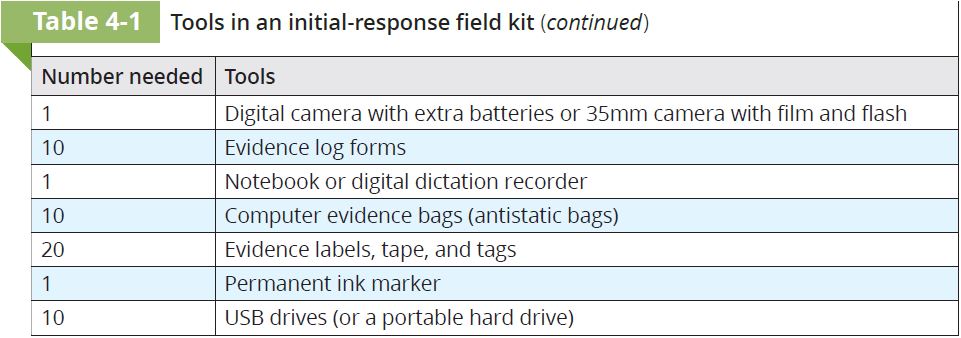
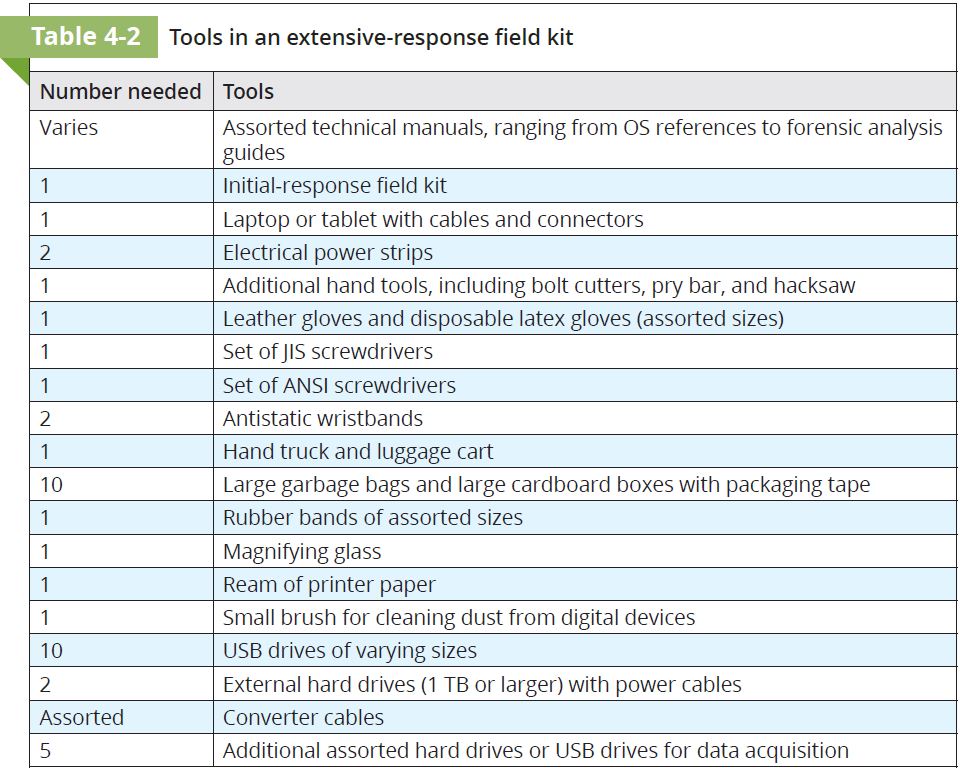
- evidence-response field kit
-
- hash value
- According to work done by Wang Xiaoyun and her associates from Beijing's Tsinghua University and Shandong University of Technology, there are three rules for forensic hashes: You can’t predict the hash value of a file or device. No two hash values can be the same. (Note that collisions have occurred in research using supercomputers.) If anything changes in the file or device, the hash value must change.
- hazardous material (HAZMAT)
- initial-response field kit
- See above
- limiting phrase
- low-level investigations
- Most cases in the private sector are considered low-level investigations, or noncriminal cases. This doesn't mean private-sector investigations are less important; it means they require less effort than a major criminal case.
- Message Digest 5 (MD5)
- National Institue of Standards and Technology (NIST)
- nonkeyed hash set
- Unique hash number generated by a software tool
- person of interest
- plain view doctrine
- probable cause
- professional curiosity
- Evidence is commonly lost or corrupted because of professional curiosity, which involves the presence of police officers and other professionals who aren't part of the crime scene–processing team. They just have a compelling interest in seeing what happened, but their presence could contaminate the scene directly or indirectly. Keep in mind that even those authorized and trained to search crime scenes can alter the scene or evidence inadvertently.
- Scientific Working Group on Digital Evidence (SWGDE)
- Set standards for recovering, preserving, and examining evidence.
- Secure Hash Algorithm version 1 (SHA-1)
- sniffing
- Real-time surveillance requires sniffing data transmissions between a suspect's computer and a network server. Network sniffer tools, such as Wireshark, allow network administrators and others to determine what data is being transmitted over the network.
- 1. Private-sector investigations are typically easier than law enforcement investigations for which of the following reasons?
- b. The investigator doesn't have to get a warrant
- 2. In the United States, if a company publishes a policy stating that it reserves the right to inspect computing assets at will, a privatesector investigator can conduct covert surveillance on an employee with little cause.
- True
- 3. In the United States, if a company publishes a policy stating that it reserves the right to inspect computing assets at will, a private sector investigator can conduct covert surveillance on an employee with little cause.
- 4. As a private-sector investigator, you can become an agent of law enforcement when which of the following happens? (Choose all that apply.)
- After you discover illegal activity and document and report the crime, stop your investigation to make sure you don’t violate Fourth Amendment restrictions on obtaining evidence. If the information you supply is specific enough to meet the criteria for a search warrant, the police are responsible for obtaining a warrant that requests any new evidence. If you follow police instructions to gather additional evidence without a search warrant after you have reported the crime, you run the risk of becoming an agent of law enforcement. Instead, consult with your organization’s attorney on how to respond to a police request for information. The police and prosecutor should issue a subpoena for any additional new evidence, which minimizes your exposure to potential civil liability. In addition, you should keep all documentation of evidence collected to investigate an internal company policy violation. Later in this section, you learn more about using affidavits in an internal investigation.
- 5. The plain view doctrine in computer searches is well-established law.
- 6. If a suspect's computer is found in an area that might have toxic chemicals, you must do which of the following?
- Some cases involve dangerous settings, such as a drug bust of a methamphetamine lab or a terrorist attack using biological, chemical, or nuclear contaminants. For these types of investigations, you must rely on the skills of hazardous materials (HAZMAT) teams to recover evidence from the scene.
- 7. What are the three rules for a forensic hash?
- 8. In forensic hashes, when does a collision occur?
- 9. List three items that should be in an initial-response field kit.
- To manage your tools' consider creating an initial-response field kit and an extensive-response field kit. Using the right kit makes processing an incident or crime scene much easier and minimizes how much you have to carry from your vehicle to the scene. Your initial-response field kit should be lightweight and easy to transport. With this kit, you can arrive at a scene, acquire the data you need' and return to the lab as quickly as possible.
- 10. When you arrive at the scene, why should you extract only those items you need to acquire evidence?
- 11.Computer peripherals or attachments can contain DNA evidence. True or False?
- 12. If a suspect computer is running Windows 10, which of the following can you perform safely?
- 13. Describe what should be videotaped or sketched at a digital crime scene.
- 14. Which of the following techniques might be used in covert surveillance? (Choose all that apply.)
- 15. Commingling evidence means what in a private-sector setting?
- protecting confidential business data that could be included with the criminal evidence (called "commingled data").
- 16. List two hashing algorithms commonly used for forensic purposes. True or False?
- 17. Small companies rarely need investigators. True or False?
- 18. If a company doesn't distribute a computing use policy stating an employer's right to inspect employees computers freely, including e-mail and Web use, employees have an expectation of privacy. True or False?
- True
- 19. You have been called to the scene of a fatal car crash where a laptop computer is still running. What type of field kit should you take with you?
- 20. You should always answer questions from onlookers at a crime scene. True or False?
- What are the general tasks investigators perform when working with digital evidence?
- Identify digital information or artifacts that can be used as evidence.
- Collect, preserve, and document evidence
- analyze, identify, and organize evidence
- Rebuild evidence or repeat a situation to verify that the results can be reproduced reliably.
- How do procedures for civil evidence compare to criminal evidence?
- Apply the same security and accountability controls for evidence in a civil lawsuit as in a major crime to comply with your state’s rules of evidence or with the Federal Rules of Evidence (FRE).
- What is the difference between [computer-generated records] and [Computer-stored records]
- cgr are what is created by the computer in lieu of what the user creates while csr is what the user creates like a letter or spreadsheet
- How are cgr verified as an exception to hearsay?
- CGR output must be functioning correctly or as intended and not altered to satisfy another illegal premise
- How are cgs verified as an exception to hearsay?
- An exception to hearsay rule, which is usually business-record exception that classifies these type of records as reliable, trustworthy and not altered.
- What is the "plain view doctrine"?
- The plain view doctrine states that objects falling in the direct sight of an officer who has the right to be in a location are subject to seizure without a warrant and can be introduced into evidence. For the plain view doctrine to apply, three criteria must be met: The officer is where he or she has a legal right to be. Ordinary senses must not be enhanced by advanced technology in any way, such as with binoculars. Any discovery must be by chance. For the officer to seize the item, he or she must have probable cause to believe the item is evidence of a crime or is contraband. In addition, the police aren't permitted to move objects to get a better view. In Arizona v. Hicks (480 U.S. 321, 1987), the officer was found to have acted unlawfully because he moved stereo equipment, without probable cause, to record the serial numbers. The plain view doctrine has also been expanded to include the subdoctrines of plain feel, plain smell, and plain hearing.
- alternate data streams
- With alternate data streams you can attach to a file and have it talk to different apps from the disk...warned about obscuring data with alternative streams
- american Standard Code for Information Interchange (ascii)
- The code that constructed from the binary code that computers use to store information...example memory slots have a byte...one byte is a one or zero and the operating system has a standard code that the permutation of those 8 two toggle memory slots can translate to. The typicla ascii code table has come from memory segments of zeors and one to hex format addressing to translate to alpha, numeric and symbols which make up the ascii table..The extended character set or unicode standard allows for translations into any language and any characters in the english language such as a $ sign or an &, numbers, alphabet.
- areal density
- Density of the platters. Space between stored bytes. A thick areal would slow down the writes but be less prone to error. A shallow areal would be quicker writes but more prone to bit flopping or error.
- attribute ID
- Attribute of the system. An attribute would be a property of an instance or an type of an event. This attribute might be different for each event but the type would still be the same. In other words you can get into a thunderbird and choose to turn on the attribute air conditioning on a warm day or turn off the air conditioning and turn on the attribute heater.
- Boot.ini
- Is a file that list the boot sequence
- BotSect.dos
- a hidden file that points to boot sector location of each OS
- bootstrap process
- basic input and output commands intialize hardware to make sure it memory components are working..and that the hardware is ready for future instruction from the OS .. it has a sequence which is held in the cmos chip that is microcode. It talks to the complete computer system comprise of many components like keyboard mouse, display, ram, and checksums them for compatibility and functionality.
- clusters
- Clusters numbered starting at 0. Clusters store one or two sectors. Clusters can range to 512 bytes to 32000 bytes. The first sector contains the contains a system area, the boot record, and file structure database. Clusters are logical addresses while cluster are logical addresses
- cylinder
- Concentric
- data runs
- NTFS feature that for files larger then 512 bytes and are stored outside of the MFT. Provides cluster addresses where the file is stored on the drive's partition. These cluster addresses are called data runs.
- device drivers
- Device drivers allow the OS to manage the specific hardware. Device(hardware)(drive) which means the OS can now drive the hardware with it's specifically design program (device driver)
- file slack
- That unwritten to area within a file size or that unwritten part of a cluseter..Still could have data there that can be accessed with tools.
- Encrypting File System(EFS)
- Feature added to NTFS for security. Use a publec and private key. The public key is held by certificate authority. A EFS has a key that is used to develop a hash of the file which makes it unreadable. You use the key to decrypt and encrypt the hash. Decrypt so humans can read and encrypt so only the computer can read it to apply the alogrithm function from the key to make it readable.
- File Allocation Table (FAT)
- Directory of the Fat file system. The file allocation table provides a standard organize structure that the operating system can consistently use to organize files by addresses..of hex---binary--microcode
- file system like fat16, fat32 and NTFS in windows
- file format for unified structure to give consistency to read and write to memory ie fat32...also limits size and controls minimum file size and it addressed through memory segments..start and end of file size with start and end of address segment...There are operating systems that depend on file standards. A disk is written differently under different file systems and different file systems have different features that allow them to be protected differently. A NTFS (New Technology File System) allowed for a large capacity on disk and added many new features for security.
- geometry
- Logical organization of cylinders, heads and sectors on disk
- Hal.dll
- A dll is a versioned file that stands for dynamic link library. This file system is accessed by the operating system and provides applications a common set of instruction to deal with like redundant processes. Example: you have a keyboard dll that all apps and OSs can access for processing keyboard commands from the OS or Applications. That's why the word linked is used because it links processes together using the accessible library. Dll's cause problems because they are versioned and when versions are changed apps don't keep up and crash or don't install. That is why docker containers are becoming important because they keep up with the dlls and provide consistency between OS and Apps or operations on the computing platform..For instance an app is working...due to security reasons the app depends on that dll crashes because the dll got updated and the app can't function...therefore the comment "DLL from hell". Since the Operating system controls the DLL the OS controls the APs from proprietory software that is force to comply to the design of the operating system.
- head
- head write hardware and the head travels concentrically around the disk
- head and cylinder skew
- The head has to skew to as it tracks around the platter
- High Performance File Sytem (HPFS)
- Info2 file
- ISO image
- File system that we can boot from. ISO images are used for virtual machines
- logical addresses
- logical cluster numbers (LCNS)
- OS assigns clusters to the drive. Assigned clusters are called logical cluster numbers (LCNS). They start from the value of 0. LCN's become the addresses that allow the MFT to link to nonresident file (files outside the MFT) on the disk partition. The LCN becoes the files virtual cluster number (VCN)
- Master Boot Record (MBR)
- Partition table is in the MBR located in sector 0 The [partition boot sector] is the first data set using NTFS. Next is the MFT.
- Master File Table (MFT)
- metadata
- data attached to the folder or file and read from properties
- NTBootdd.sys
- Allow the system to communicate with the SCSI or ATA drives
- NTDetect.com
- 16 bit real mode program that queries the device and configuration data and passes it to NTldr
- NT File System (NTFS)
- Journaling file sytem. Keeps track of transactions such as file deleteing or saving. Provides persistence or place marker if power failure or it can go back to the last setting. NTFS results in less file slack. NTFS use unicode 8, 16, 32 bit configuration instead of ascii 8 bit. UTF-8 is identical to ASCII. Records in the MFT are called metadata.
- NT Loader (Ntldr)
- Loads the operating system
- Ntoskrnl.exe
- Operating system kernel which the instruction sets talk to.
- one-time passphrase
- Pagefile.sys
- partition
- A partition is a logical drive. Windows partitions have three primary partitions followed by an extended partition that can contain one or more logical drives. Some one can hide data on a hard drive using hidden partitions. Resizing the hard drive smaller also provides a way to hide data. You can create a partition then remove the letter designation to it, thus hidding it.Partitions of the file system that allow you to logically partition off the OS system to a drive letter with a defined memory space. Also allows you to create other formatted partition designated by other drive letters like a,c,d,e,f,g ....b is never used and "A" is reserved for the legacy floppy disk platters.
- Partition Boot Sector
- Section of the partition that contains the boot instruction set for the computer. Hackers use to like to get to this area and corrupt it
- personal identity information (PII)
- Personal identity information is sometimes metadata attached to a file describing who created the file and other information like camera used, dates/times and geolocation and anything you want. PII is a vulnerabiltiy
- physical addressses
- The physical address the mac address of the hardware known as the mac address.
- private key
- Part of the public private key exchange. The private key is not available. The public key is available by Certs. There is asynchronous and synchronous
- public key
- Public keys are availble by both parties of the transactions.
- ram slack
- Clusters contain sectors. Sectors leave space between the end of the file in the sector it uses and the endo of the cluster. RAM slack is written to in zeros in this space on new systems. There is also file slack. Explanation: The data to fill the 120-byte void is pulled from RAM and placed in the area between the end of the file (EOF) and the end of the last sector used by the active file in cluster. Any information in RAM at that point, such as logon IDs or passwords, is placed in RAM slack on older Microsoft OSs when you save a file. File fragments, deleted e-mails, and passwords are often found in RAM and file slack. Copyright 2019 Cengage Learning. All Rights Reserved. May not be copied, scanned, or duplicated, in whole or in part. Due to electronic rights, some third party content may be suppressed from the eBook and/or eChapter(s). Editorial review has deemed that any suppressed content does not materially affect the overall learning experience. Cengage Learning reserves the right to remove additional content at any time if subsequent rights restrictions require it. Copyright
- recovery certificate
- Registry
- windows database for configuration
- resilient file System (ReFS)
- I an outgrouwth of NTFS designed to provide a large -scale data storage access capability. Added shadow paging.
- sector
- formed by concentric tracks
- track density
- Space between each track
- tracks
- concentric tracks along the round magnetic plates
- unallocated disk space
- That disk space that has not been partitioned or formatted with a file system
- Unicode
- Standard used as a character library that humans can read and write to and translate memory to human readable form. That format has been change over the years to extensible to foreign languagea and other types of characters.
- UTF-8 (Unicode Transformation Format)
- A Transformtion format used on the web
- virtual cluster number (VCN)
- Provides a logical number to identify a vitural collection of memory spaces or segments joined together for continous reads and writes
- virtual hard disk (VHD)
- Vitual harddisk are Disk boundaries describe from memory addresses which don't have to be contiguous. This give the virtual machine the ability to create partitions with the existing file system for writing and reading to memory
- virtual machines
- Virtual machines are created on demand within a memory space. This allows free formatted partitions to contain many virtual machines when you access them from the file system using a virtual machine manager. Each manager can store different virtual machine which equal a computer with many different Operating systems. Each virtual machine can boot on demand from the Virtual Machine manager.
- wear-leveling
- zone bit recording (ZBR)
- ZBR is how "most" manufacturers deal with a platter's inner tracks which has a less space to store data. Grouping tracks by zones ensures that all tracks hold the same amount of data.
- What size are sectors in bytes?
- A sector is size on hardware as a continouse address space. A sector could be different sizes. Sectors are organized in clusters.
- CHS?
- What is zone bit recording?
- Areal density?
- Clusters in Windows always begin at what number?
- How many sectors in a cluster?
- Varies depending on drive size....sectors per cluster
- List three items stored in the fat database
- file names, directory names, date and time stamps, the starting cluster number and file attributes (archive, hidden, system, and read-only
- Ntuser.dat file contain?
- User-protected storage area; containsthe list of most recently used files and desktop configuration settings
- In FAT32, 123 KB file uses how many sectors?
- What is the space on a drive called when a file is delected?
- slack
- List two features NTFS has that FAT does not?
- Encryption and accomodates larger size.
- MFT?
- Tracks NTFS file information
- In NTFS, files smaller than 512 bytes are stored in the MFT?
- In Windows 7 and later, how much data from RAM is loaded into RAM slack on a disk drive?
- Virtual cluster number?
- Why was EFI boot firmware developed?
- Provide user access from the operating system?
- Device drivers contain what kind of information?
- Instructions allowing the operating system to talk to Devices
- Which of the following Windows 8 files contains user-specific information? user.dat, ntuser.dat, system.dat, sam.dat
- Virtual machines have which of the following limitations when running on a host computer?
- An image of a suspect drive can be loaded on a virtual machine. True or False?
- EFS can encrypt which of the following?
- NTFS file systems
- What happens when you copy an encrypted file from an EFS-enabled NTFS disk to a non-EFS disk or folder?
- The file decrypts.
- What is a recovery certificate and how is it handle?
- Provides a way to recover the certificate using the [EFS Recovery Key Agent] You can intiate a recovery two way, throught windows or from a command prompt using cipher or copy.
- Whole Disk Encryption
- Prevent divulging of data when device stolen.
- What is a good third party tool accessing registry?
- FTK Registry viewer
- Downloaded to computer
Employee Termination Cases
Internet Abuse Investigations
Internet Abuse Investigations
Email Abuse Investigations
Attorney-client Privilege
Attorney-client Privelege
Industrial Espionage Investigations
Understanding Data Recovery Workstations and Software
Interview and interrogations in High-Tech Investigations
Understanding Data Recovery using Workstations and Software
Important Step Critiquing the Case Questions
Summary
Chapter Two Lab Download and try autopsy March 20, 2020
I created a lab on using Autopsy
Chapter Two
Terms
Chapter Two
Review Question
Chapter Three
Key Terms
Review Questions
Chapter Four
Key Terms
Chapter four review questions
My Questions for Chapter Four
Steve Gibson Security Now
March 27, 2020, Adobe Font zero day
Phishing Help
Testing SSL, TLS with browser. Browser test on the fly
">Chapter Five
Key Terms
Review Questions
Chapter Six
Terms
- acquisition
- brute-force attack
- run on encrypted file if rainbow tables fail
- Computer Forensics Tool Testing (CFTT)
- NIST provides guidelines for testing new tools
- extraction
- keyword search
- National Software Reference Library
- list of known file hashes for a variety of OSs, applications and images. Also hash values for mobile apps, specifically IOS and Android
- password dictionary attack
- dictionary of passwords to use to break the system. Passwords are usually one way hashes...meaning you can not apply an algorithm to break them.
- reconstruction
- Recreates a suspect drive to show what happened during a crime or incident. Methods for reconstruction are disk to disk copy, partiiton to partition copy, image to disk copy, image to partition copy, disk to image copy and rebuilding files from data runs and carving.
- validation
- validates the tool
- verification
- verifies the data
- write-blocker
- Simplest write of disk
- The simplest method of duplicating a drive is using a tool that makes a direct disk-to-image copy from the suspect disk to the target location.
- Shadowing a Drive
- Time critical...attach parrallel drive and all writes go to it when live. Useful in court to show evidence
- 1. Forensics software tools are grouped into ______ and ____ applications.
- 2. According to ISO standard 27037, which of the following is an important factor in data acquisition? (choose all that apply)
- Should use validated tools. Fuction categories to check: Acquisition, validation and verification, Extraction, Reconstruction and Reporting. Additional function are data acquistion, data extraction from modbil devices, file reconstruction, and string seaching.
- 3. An encrypted drive is one reason to choose a logical acquistion. True or False
- 4. Hashing, filtering, and file header analysis make up which function of digital forensics tools?
- 5. Hardware acquisition tools tyically have built-in software for data analysis? True or False
- 6. The reconstruction function is needed for whic of the following purpose?
- 7. List three subfunction of the extraction function?
- 8. Data can't be written to disk with a command-line tool? True or false True with nix dd but flat file same size as drive.
- Tasks list explained:
-
- Acquistion which includes subfunction: Physical data copy, Logical data copy, Data qcquistion format, command-line acquistion, GUI acquistion, Remote, live and memory acquistions. Validation and Verification is a way to confirm that a tool is functioning as intended and verification proves that two sets of data are identical
- Extraction: is the recovery tasks and the most challenging of all tasks to master..subfunctions of extraction are Data viewing, keyword searching, decompressing or uncompressing, carving, decrypting and bookmarking or tagging
- Reconstruction: Recreates a suspect drive to show what happened during a crime or incident. Methods for reconstruction are disk to disk copy, partiiton to partition copy, image to disk copy, image to partition copy, disk to image copy and rebuilding files from data runs and carving.
- Reporting: New forensics software can put all data formats into one format to make it easier to produce reports. Reporting mechanisms includ Bookmarking or tagging, log repors , timelines and report generator
- Older version of software
- Keep older versions...updates could be buggy
- allocation block
- Apple File System (APFS)
- File system provides recovery by written meta data. A file consists of two parts: a data fork where data is stored and a resource fork where file metadata nd application information are stored.
- B + - tree
- File mapping information is stored in two location. It is also used to organize the direcotory hierarchy and file block mapping.
- bad block inode
- boot block, superblock, inode block and data block
- boot block can be 512 bytes and up and it depends on how the disk block was intialize..it contains the bootstrap code, superblick contains is considered part of metadata. Inode blocks contain the first data after the superblock. An inode is assigned to every file allocation unit. Data blick is where directories and file are stored on a disk drie.
- catalog
- clumps
- data block
- data fork
- Where Data is stored in the file system
- double-indirect pointers
- second inode layer pointer which points to 128 additional pointer inodes
- Extended Format File System (HFS+)
- HFS, HFS+ and APFS
- extents overflow file
- fourth extended file system (Ext4)
- Add support for larger then 16 TB
- hard link
- header node
- hierarchial File System (hfs)
- index node
- indirect pointers
- inode blocks
- inodes
- keychains
- used to manage passwords and can be useful to find what applications and files require passwords.
- link count
- logical block
- logical end of file EOF
- map node
- Master Directory Block (MDB) in HFS+
- All information about a volume is stored in the MDB and written to when the volume is initialized. A copy of the MDB is also written to the next-to-last block on the volume to support disk utility functions.
- physical EOF
- plist files
- are preference files for installed applications on a system.
- resource fork
- Where meta data is stored
- Second Extended File System (EXT2)
- linux file system
- superblock
- symbolic links
- tarball
- Is a high compressed data file containing oneor more files or directories and their contents. Typically has .tar or .gz extention
- Third Extended File system
- add journaling which has built in file recovery to mitigate a crash
- triple-indirect pointer
- unified logging
- Contains three logging utilities log, log collect and log show that are available for a forensics examiner
- Volume Control Block (VCB)
- 1. Explain the differences in resource and data forks used in macOS.
- 2. Which of the following is the main challenge in acquiring an imag of system running macOS? (Choose all that apply.)
- 3. To recover a pasword in macOS, which tool do you use?
- 4. What are the major improvements in Linux Ext4 file system?
- 5. How does macOS reduce file fragmentation?
- 6. Linux is the only OS that has a kernel?
- 7. Hard links work in only one partition or volume?
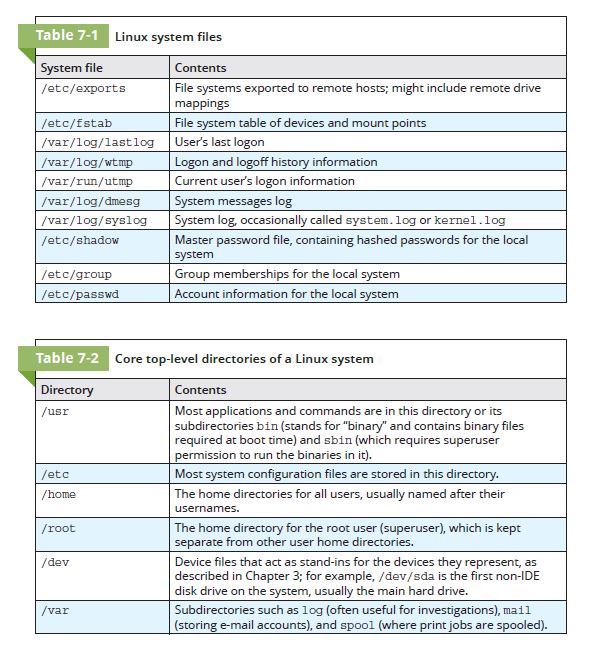
- 8. Whico of the following Linux system files contains hashed passwords for the local system?
- Which of the following describes the superblock's function in the Linux file system?
- bitmap images>
- values are map to a small area on the sreen. Smaller areas = higher resolution. Bit one is 34f569da. It represents a color.
- carving
- Another term for salvaging. Finding corrupted or mask relevant data that identifies or describes the file
- data compression
- Two types lossless lossy. One deletes original data and one preserves it. Used to make files more manageable for email and available storage
- demosaicing
- Exchange
- Exif exchangeable Image
- Format of a image file
- fair use
- Can't resell it
- false positives
- Something reported as true that is false
- LSB
- bit in byte
- losseless compression
- Does not delete and uncompresses to original file
- lossy compression
- deletes and cannot become original file
- metafile graphics
- Graphics in metada
- MSB
- Most significant byte
- nonstandard graphics file formats
- File formats that are proprietory or changed to mask
- pixels
- One box on the screen that holds data.
- raster images
- jpeg ---> vector
- raw file format
- original hex file with values for each pixel
- resolution
- high resolution: most pixels per squrare inch, low resolution less pixels per square inch. If the data is not there you can't represent it.
- salvaging
- Another term for carving. To carve a graphics file’s data from file slack space and free space, you should be familiar with the data patterns of known graphics file types known graphics file types. Many digital forensics
- standard graphics file formats
- .tiff, .tif (trivial), .bmp (windows), .giff (lightweight), .png(web), .jpg, .jpeg, (joint photographers experts group), .tga
- What is .tga format?
- Truevision Targa (.tga): Developed by Truevision Inc. TGA files is a file format that will support images suitable for display on Targa hardware but is supported by many applications on a wide range of platforms.
- vector formats
- math equations
- vector quantization VQ
- Another form of lossy compression, vector quantization (VQ), uses complex algorithms to determine what data to discard based on vectors in the graphics file. In simple terms, VQ discards bits in much the same way rounding off decimal values discards numbers.
- Graphics file stored on a computer can't be recovered after they are deleted? False
- When you carve a grahpics file, recovering the image depends on which of the following skills?
- Reading header information and ctkg
- Explain how to identify an unknown graphics file format that your digital forensics toll doesn't recognize
- Carving header
- What type of compression uses an algorithm that allow viewing the graphics file without losing any portion of the data?
- lossless
- When investigating graphics file, you should convert them into one standard format?
- false
- Digital pictures use data compression to accomplish which of the following goals?
- email, smaller manageable files, less storage
- The process of converting raw images to another format is called which of the following? raster?
- In JPEG files, what's that starting offsett position for the JFIF label?
- Each type of graphics file has a unique header containing information that distinguishes it from other types of grahpics file
- true
- Copyright laws don't apply to Web sites?
- false
- When viewing a file header, you need to include hexadeciaml information to view the image.
- true?
- When recovering a file with ProDiscover, you first objective is to recover cluster values?
- yes in windows
- Bitmap (.bmp) files use which of the following types of compression?
- A JPEG file uses which type of compression?
- lossy
- Only one file format can compress graphics files?
- false
- A JPEG file is an example of a vector graphic?
- false pixel description vs mathematical equations
- Which of the following is true about JPEG and TIF files?
- What methods do stegangraphy programs us to hide data in graphic files?
- Some clues left on a drive that might indicate stagnography include which of the following?
- duplicate files, same file different diff, change file ext, tool on computer
- What methods are used for digital watermarking?>
- layering values are map to a small area on the sreen. Smaller areas = higher resolution. Bit one is 34f569da. It represents a color.
- Why are data structures important to graphical files?f
- How to find graphic files?
- In a digital forensics investigation involving graphics files, you need to locate and recover all graphics files on the suspect drive and determine which ones are pertinent to your case. Because images aren’t always stored in standard graphics file formats, you should examine all files your forensics tools find, even if they aren’t identified as graphics files.
- bit shifting
- move bits left or right
- block-wise hashing
- Using hashes of a sector in a file to look for sectors somewhere else to tie that file to suspects computer. Like in deleted files or on another memory device.
- cover-media
- key escrow
- Holds key during transaction
- Known File Filter (KFF)
- Filters file
- rainbow table
- hashes of known passwords
- salting passwords
- adding an additional input to alter encryption of a password
- scope creep
- investigation finds outside of scope interesting activity
- steganography
- Hiding a message
- stego-media
- media that hides message
- Which of the following represents known files you can eliminate fom an investigation?
- Redundant process files
- Fow which of the following reasons should you wipe a target drive?
- To begin new. To insure no viruses. To clean data X-Ways Security, Digital Intelligence PDWipe, or WhiteCanyon SecureClean.
- The Known File Filter (KFF) can be used for which of the following purposes?
- Password recovery is included in all forensics tools?
- After you shift a file's bits, the hash value remains the same. false
- Which forensic image file format creates or incorporates a validation hash value in the image file?
- What happens when an investigation goes beyound the bounds of its original description.
- beyound scope
- Supports you're investigating an email harassement case. Generally, if collecting evidence for this type of case easier for an internal corporate investigation or a criminal investigation?
- You're using Disk Management to view primary and extended partitions on a suspect's drive. The program reports the extended partition's total size as larger than the sum of the sizes of logical partitions in this extended partition. What might you infer from this information?
- hidden
- Commercial encryption programs often rely on what technology to recover files if a password or pass phrase is lost?
- Steganography is used for which of the following purposes?
- Hide data
- The National Software Reference Library provides what type of resource for digital forensics examiners?
- known hashes
- In steganalysis, cover-media is which of the following?
- Rainbowtables serve what purpose for digital forensics examinations?
- all password hashes
- The likelihood that a brute-force attack can succed in cracking a password depends heavily on the password length?
- T
- If an application use salting when creating passwords, what concerns should a forensics examiner have when attempting to recover passwords?
- Hard
- Block-wise hashing has which of the following benefits for forensics examiners? One advantage of using hashes of sectors is that you can look for known file fragments. Once you have the hash you can look for other matches. If it is deleted you can use a sector to look for the file
- Validating and refining
- Investigators goal and scope, the materials needed, and the tasks to perform.
- Basic steps
- wipe drive
- Inventory hardware
- rm sda and check cmos for date and time
- tool to image drive, hash type
- Process data methodically and logically
- list hierarchy and note relationship to target evidence
- Start at root and examine all evidence
- attempt to break password/encryption
- function of binary or .exe files. Note system files out of place.
- Maintain control of all evidence nd findings. Document everything.
- Advanced hexadecimal editors have many features not available in digital forensics tools, such as hashing specific files or sectors.
- Defense in depth (DID)
- outer, middle, inner
- Distributed denial-of-service (DD0S)
- Continous requests from machine/machines that overflow the targets memory buffers
- honeypot
- A machine set up to be used for penetration testing. This allows the tester to control the source and the target for investigations
- honeywalls
- layered network defense strategy
- Provide three barriers that become increasing difficult to penetrate starting with outer, then middle and inner. The inner layer is where the important data is secured.
- network forensics
- order of volatility
- packet analyzers
- Describes network traffic flow from
- type 1 hypervisor
- Sits on top bare metal
- type 2 hypervisor
- Is a client to a host Operating system that sits on bare metal
- Virtualization Technology
- Technology developed by Intel that allows for security and implementation of Virtual Machine disk that host operating systems
- Virtual machine Extensions
- zero day attacks
- Malicious software that target application/OS that has not been patch to protect itself.
- zombies
- Virtual Machine Extensions are part of which of the following?
- You can expect to find a type 2 hypervisor on what type of device?
- Which of the follwoing file extensions are associated with VMware virtual machines?
- .vmdk
- In VirtualBox, an _________ file contains setting for virutal hard drives
- The number of VMs that can be supported per host by a type 1 hypervisor is genrally determined by the amount of _____ and _______?
- Harddrive space and ram
- A forensic image of a VM includes all snapshots? t or f
- Which registry key contains association for file extensions?
- whic of the follwoing is a clue that a virtual machine has been installed on a host system?
- Presence of VMs storage folder and VM software
- To find network adapters, you use the ____ command in Windows and the ifconfig command nix.
- ipconfig
- What are the three modes of protection in the DID strategy?
- Outer, Middle, Inner
- A layered network defense strategy put the most valuable data where?
- Inner layer
- TCPslice can be used to retriev specific time frames of packet captures? t or f
- Packet analyzers examine what layer of the OSI model?
- 2 and 3
- When do zero day attacks occur?
- Before Patches
- client/server architecture
- many clients to one server. Servers can provide an email server.
- electronic Communications Privacy Act
- Enhanced/extended Simple Mail Transfer Protocol, ESMTP
- Unique ESMTP number in the message header. Helps to authenticate email.
- Forensic Linguistics
- language of law, process, evidence and research/teaching. Forensic linguistics can determine a speakers dialect and sometimes where a person is from based on phrases. They cannto determine and author's veracity or gender.
- Internet Message Access Protocol 4
- mbox
- Messaging Application Programming Interface
- Multipurpose Internet Mail Extensions (MIME)
- Onlin social Networks (OSNs)
- Pharming
- phishing
- Post Office Protocol version 3 (POP3)
- Simple Mail Transfer Protocol (SMTP)
- SPOOFING
- Stored Communications Act (SCA)
- Make sure you know the applicable privacy laws in the US
- E-mail headers contain which of the following information?
- What' the main piece of information you look for in an e-mail message your're investigating?
- In Microsoft Outlook, e-mails are typically stored in which of the following?
- When searching a victim's computer for a crime committed with a specific e-mail, whic of the following provides information for determining the e-mail's originator?
- Phishing doee which of the following?
- Which of the following is a current formatting standard for e-mail?
- After examining e-mail headers to find an e-mail's orgination address, investigators use forward lookups to track an e-mail to a suspect?
- When you access your e-mail, what type of computer architecture are you using?
- To trace an IP address in an e-mail header, what type of lookup service an you use?
- Router logs can be used to verify what types of e-mail data?
- Logging option on e-mail servers ca be whic of the following?
- On a UNIX-like system, whic file specifies where to save different types of e-mail log files?
- What information is not in an e-mail header?
- Which of the following types of files can provide useful information when your're examining an e-mail server?
- E-mail accessed with a Web browser leaves file in a temporary folder?
- When confronted with an e-mail server that no loger contains a log with the date information you need for your investigation, and the client has deleted the e-mail, what should you do?
- You can view e-mail headers in Notepad with all popular e-mail clients?
- To anlyze e-mail evidence, an investigator must be knowledgeable about an e-mail server's internal operations?
- Sendmail uses which file for instruction on processing an e-mail message?
- A forensic linguist can determine an author's gender by analyzing chat logs and social media communications?
Chapter six Review Questions
Chapter Seven
Terms
Chapter seven Review Questions
Chapter Eight Terms
Chapter Eight Review Questions
Chapter Nine Terms
Chapter Nine Review Questions
New!! Theme and context
Chapter Ten Terms
New!! Theme and context
Chapter Ten Review Questions
Chapter Ten Terms
Chapter Ten Review Questions